


Page 20 - Hoag Orthopedic Institute 2012 Outcomes Report
P. 20
INFECTION PREVENTION CONTINUED
LENGTH OF STAY
Reducing hospital lengths of stay (LOS) decreases the likelihood of hospital-acquired complications, thereby reducing healthcare costs. For many patients, appropriately reduced LOS means they are able to recover in the comfort of their home and recuperate in a more restful environment.
Although hospitals have lowered their average lengths of stay in the past two decades, overall LOS can be decreased for many patients through clinical best practices and discharge planning. Many delays can be traced to medical complications; others involve waiting for equipment, test results or a clinical decision, and can be rectified with coordination of resources throughout hospitalization.
HOI has taken several steps to ensure safe and expedient lengths of stay. When the decision to proceed with surgery is made, a nurse navigator contacts the patient prior to admission and addresses any issues regarding discharge planning. Pre-op patient orientation classes
set patient expectations and help smooth the discharge process. Nurse navigators follow patients across the continuum of care, focusing on education, provider collaboration and development of an integrated plan of care. The navigator will work with each patient’s needs and troubleshoot problems should they arise.
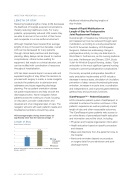
HOI’s average lengths of stay, shown below, are significantly lower than the national average.
Additional initiatives affecting lengths of stay include:
Impact of Rapid Mobilization on
Length of Stay for Postoperative
Joint Replacement Patients
Overall length of hospital stay following total
joint replacement can be reduced through rapid mobilization, according to a study presented at the 2012 American Academy of Orthopaedic Surgeons. References addressing change in postoperative activity on day one date back to World War II. Furthermore, as the nursing textbook by Lewis, Heitkemper and Dirksen, 2004, Study Guide for Medical-Surgical Nursing, states, “Early ambulation is the most significant general nursing measure to prevent postoperative complications.”
Commonly accepted postoperative benefits of early ambulation implemented at HOI include a decrease in venous stasis, stimulation of circulation, prevention of deep venous thrombosis/pulmonary embolism, increases in muscle tone, coordination and independence, and improved gastrointestinal, genitourinary and pulmonary functions.
iCarePassportTM – Patient Education
HOI’s interactive patient system iCarePassport is intended to enhance the entire continuum of the patients’ experience as well as positively impact length of stay and other measurable outcomes. The iCarePassport gives patients web access to an online library of personalized health education and information around the clock, including:
• Physician and hospital organization information
• Health education based on specific procedure
and disease
• Maps and directions from the patient’s home to
the hospital
• Alerts and reminders (based on procedure
or surgery date) for pre-admission and post- discharge events
Length of Stay
Days (Lower is Better)
5
4
3
2
1
0
Review, July 2012
4.3
2.5
Hoag Orthopedic Institute
National Source: Hoag Finance, Oct 2011-Aug 2012. n = 3,483; Becker’s Hospital
20 | HOAG ORTHOPEDIC INSTITUTE


